Review: Scotty Depthpower Downrigger 1106.
Updated: Jan 26
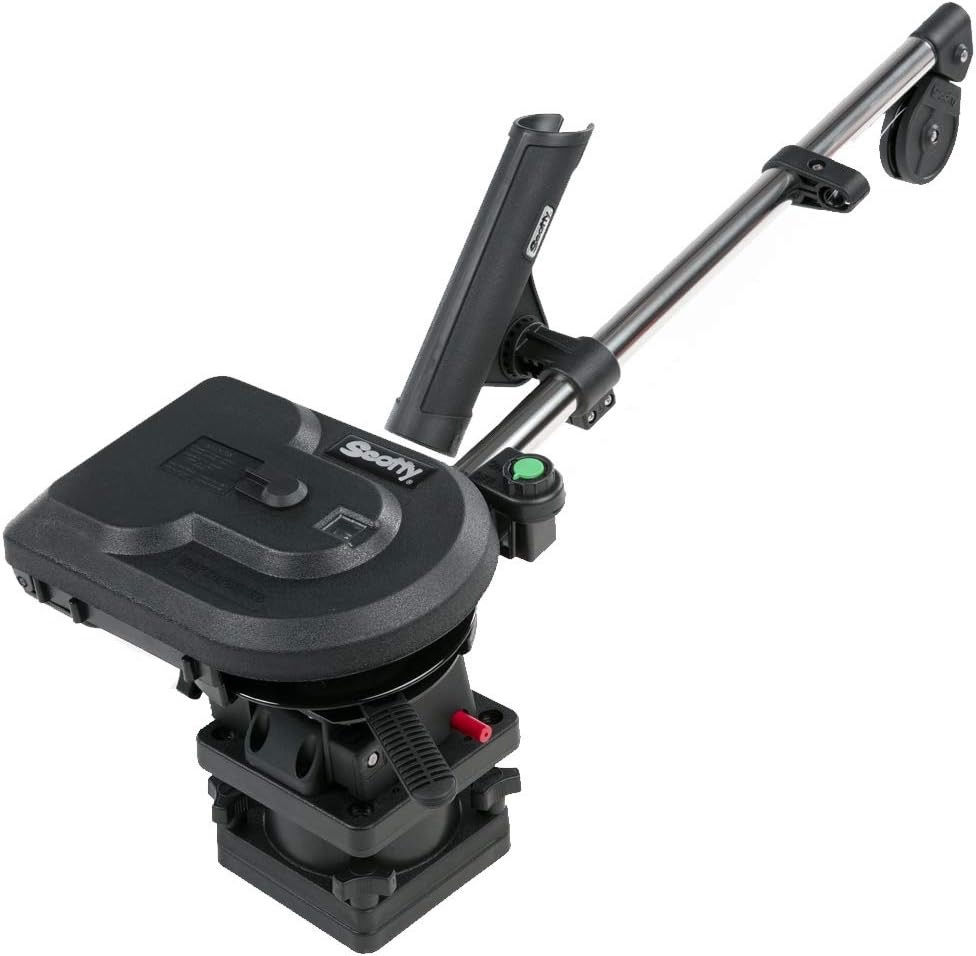
The Scotty Depthpower Downrigger is a tough, reliable workhorse, and you don’t have to look far on the west coast of BC to see that they are by far the preferred choice among most recreational salmon anglers and guides.
I have used them for decades, and currently own 7 of them covering my two boats.
Standout features include sturdy, marine resistant build, simple and effective design, ease of operation, reliability, and the legendary Scotty warranty and service.
Scotty makes two versions of its electric downriggers: The High Performance 2106, and the Depthpower 1106. The main difference between the two is that the 2106 has a slightly bigger motor, and a quicker retrieval time. Otherwise, they are virtually the same machine, and operate the same way.
While I only own the Depthpower 1106 models, I have used both, and in my opinion, the only reason you would “need” the 2106 model, is if you were predominantly fishing at depths of 150 ft or more. At those depths, you would most likely be dealing with at least an 18 pound weight, and while the 1106 will handle that weight as well, the quicker retrieve time of the 2106 would make a difference over the course of a day fishing at those depths.
If, like me, most of your fishing is shallower than 150 feet, the Depthpower 1106 will be just fine.
***check price here***
As an Amazon Associate I earn from qualifying purchases.
While I’ve never actually timed the retrieval speeds on either model, Scotty says that with a 15lb weight, the 2106 goes 295ft/min with a 14.5 amp draw, and the 1106 goes 203 ft/min with an 8 amp draw. The retrieval rate on the 2106 is noticeably faster, but since most of my fishing is at about 80ft and above, the real time difference only amounts to a few seconds. And depending on your power and battery setup, the increased draw of the 2106 may come into play for some as well.
The other main difference from a user perspective is that the 2106 uses a digital (electronic) line counter, whereas the 1106 uses a mechanical one. Since knowing your depths is extremely important, the line counter is a bigger deal that it might first sound, as having one go down can really mess up your fishing day.
The pros of the digital counter are, the numbers are bigger and illuminated, and re-setting the counter to zero is an easy push of a button. The cons of the digital counter are that they run on double AA batteries, can be susceptible to moisture, and they cost about 3 times as much as a mechanical counter.
The pros of the mechanical counter are that it doesn’t need batteries, and they are fairly cheap to replace. The one big drawback of the mechanical counters is, zero-ing out the counter after you’ve lost some line, or put some more on. Frankly it’s a huge pain in the butt, as you need to manually flick the counting wheel with your finger.
Despite this, my vote is still for the mechanical counter. Why? Simply because the chances that I will have a spare set of good, double AA batteries on board at any given time are slim to none. So while I truly hate re-setting the mechanical counter manually, I can do it and keep fishing without doing math each time I lower my gear, versus somehow trying to conjure up a double AA battery out of thin air.
Replacing either digital or mechanical counters is quick and easy but is a also lot more economical (and reasonable) to carry a spare mechanical counter on board versus a digital one.
Finally, there are also those times in fishing when a speedy retrieval rate may not exactly be your best friend. Two specific instances are: A) when you are snagged up on something that you shouldn’t be, such as the bottom, a log, kelp, crab trap or whatever; and B) on those occasions that your auto stop bead has fallen off your downrigger line.
In my experience, when your snag up on anything solid, the quicker retrieve usually pulls a lot harder and faster than you want as your try to manoeuvre around your snag to try and save your gear - especially when currents might be pushing you around at the same time. Similarly, once in awhile, you lose your auto-stop beads, and the quicker retrieve can suck all your gear back up into the pulley quicker than you can react which can lead to breakages and lost gear.
All in all, you can’t really go too far wrong with either model. And for those times when things go wrong, both are easy to work on, brake adjustments if needed are simple to do, and the counters are easily replaced. In other words, short of catastrophic failure, you can do any small repair or tweak needed right on the water, and not have it ruin your entire fishing day. And on that point, I also greatly prefer using braided line vs steel cable no matter what model (see full review and reasons here).
Finally, there are two small things I wish were different on the Depthpower 1106’s. First, I would love it if the mechanical counters had a little re-set button on them to zero them out. Second, I wish these downriggers came with a replacement pin which holds the downrigger onto the swivel mount. They come with a threaded stainless steel pin which works just fine, but is a little awkward and takes about 20 half-turns to get it fully in or out. It would be far easier and quicker to have a pin with a toggle end to secure it, rather than threads, like the one on the Ace Line Hauler which fits in the Scotty mount, but that’s another review altogether…


Comments